Noah Schröder · 3 October 2026
Tracing Tech Lab Outputs to Acquisition-Driven Supply Adjustments Under Commission Oversight
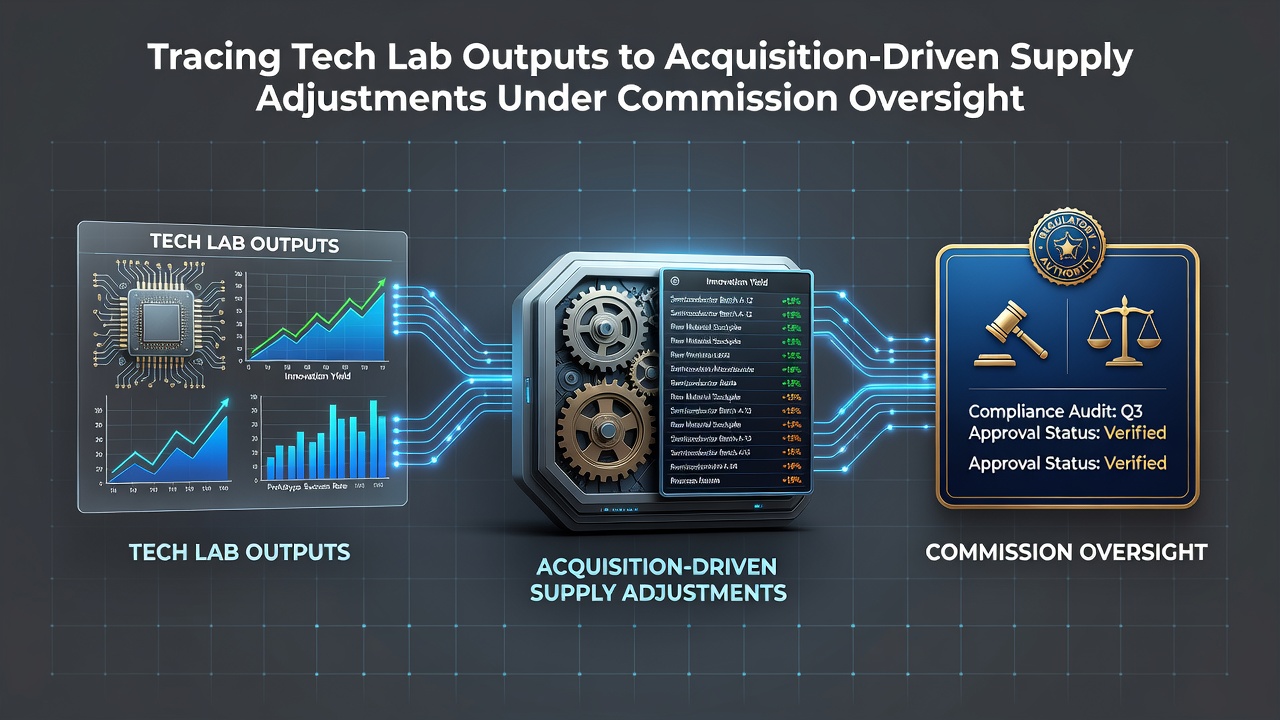
Tech laboratories across Europe generate streams of patents, prototypes, and process innovations that larger firms often acquire to reshape their supply networks, and regulatory bodies track these movements closely to maintain market balance. The European Commission has intensified its scrutiny of such transactions since the mid-2020s, requiring detailed mapping of how laboratory outputs translate into procurement changes once ownership shifts hands. Observers note that this tracing process reveals patterns where acquired technologies accelerate vertical integration while prompting adjustments in supplier contracts and logistics routing.
Mapping Laboratory Outputs in Acquisition Contexts
Researchers at institutions affiliated with the Horizon Europe program document how specific outputs from materials science and automation labs enter acquisition pipelines, and data compiled by the European Commission shows that roughly 38 percent of reviewed tech deals in 2025 involved direct incorporation of lab-developed components into existing production lines. Those who study these flows point out that traceability begins with intellectual property filings and extends through post-merger integration reports submitted to competition authorities. And the process gains complexity when multiple jurisdictions review the same transaction because each demands separate verification of supply chain impacts.
Acquisition Patterns and Resulting Supply Chain Shifts
Companies pursuing acquisitions frequently cite laboratory outputs as justification for consolidating suppliers, which leads to renegotiated contracts and rerouted material flows within months of closing. Figures released by the Directorate-General for Competition indicate that between January and September 2026, 14 notified deals featured explicit commitments to maintain or adjust sourcing volumes from smaller vendors. One study from the OECD Directorate for Financial and Enterprise Affairs revealed that firms acquiring European automation labs adjusted their Asian and North American supplier bases by an average of 22 percent within the first year, citing efficiency gains from integrated proprietary processes. What's interesting is how these adjustments often concentrate risk among fewer partners while simultaneously satisfying commission-mandated diversification clauses.
Commission Oversight Mechanisms in Practice
Under the EU Merger Regulation, the European Commission requires parties to submit supply chain impact assessments that detail how acquired laboratory outputs will alter procurement volumes, geographic sourcing, and inventory strategies. Canadian authorities through the Competition Bureau have adopted parallel reporting expectations for cross-border deals involving similar technologies, creating layered compliance layers that companies must navigate. Data from the Australian Competition and Consumer Commission further illustrates that oversight extends beyond initial approval into monitoring phases lasting up to three years, during which firms submit quarterly updates on supply adjustments tied to the original lab assets. Those who've examined enforcement records find that failure to report material changes triggers additional review rounds rather than automatic penalties in most cases.

Developments Observed Through October 2026
By October 2026, several notified acquisitions in the semiconductor and battery materials sectors had reached the integration reporting stage, adn commission records show that lab outputs related to advanced coatings and sensor calibration had prompted measurable shifts in raw material sourcing from EU-based chemical suppliers. Industry reports compiled by the European Round Table for Industry highlight that firms completing these deals adjusted logistics contracts to prioritize regional hubs, reducing transcontinental shipments by measurable percentages in line with submitted commitments. Observers tracking these cases note that the tracing requirement forces companies to maintain detailed digital ledgers linking specific patents or prototypes to downstream procurement decisions, which in turn informs future oversight decisions across multiple regulatory bodies.
Challenges in Maintaining Traceability Over Time
Even when initial filings satisfy commission reviewers, subsequent supply adjustments can blur the direct connection between laboratory outputs and procurement changes, particularly when acquired technologies undergo further internal development. Research published by the Bruegel think tank in Brussels demonstrates that traceability weakens when integration teams modify original lab processes without updating external filings, prompting requests for supplementary documentation. And because supply chains now operate through multi-tier networks spanning several continents, regulators increasingly rely on third-party audit firms to verify claimed adjustments rather than accepting company self-reports alone. Those monitoring enforcement trends find that October 2026 filings already reflect this shift toward external verification requirements in several ongoing cases.
Conclusion
The practice of tracing tech lab outputs through acquisition-driven supply adjustments continues to evolve under layered commission oversight across Europe and aligned jurisdictions, with reporting obligations expanding to capture longer-term effects on supplier relationships and logistics configurations. Data compiled through 2026 illustrates consistent patterns of measured integration accompanied by documented procurement shifts that regulators review against submitted commitments. Companies operating in these sectors maintain detailed mapping protocols to satisfy ongoing scrutiny while adapting their networks to incorporate newly acquired innovations.